
- Oliver Hume Land Index and Residential Outlook is Australia’s first and only quarterly, multi-market analysis of the land sector and draws on Oliver Hume’s decades of proprietary data.
- The release of the first Index shows most Australian land markets in good health, with Perth leading the way, followed by South East Queensland and Adelaide.
- Historically the country’s biggest market for land sales, Melbourne, is still operating below normalised levels and well below other major markets.
Leading property and research company Oliver Hume has unveiled the country’s first comprehensive quarterly land index that will draw on decades of data and industry expertise to spotlight opportunities and risks in Australia’s $16 billion new land market. Full Index available HERE.
Oliver Hume Property Group CEO Julian Coppini said the Index was the first of its kind in Australia to focus on the new land market and was based on proprietary datasets covering decades of sales in key markets.
“This will be an absolute game-changer for our understanding of the state of the new land market and fills a yawning gap in the existing research on the Australian property market. It is only possible because Oliver Hume has spent decades investing in data and research.”
“Volatility has become the new norm in Australia’s land market and buyers, developers and governments face a constant battle to stay up to date and respond to changing conditions,” he said. “The Oliver Hume Land Index and Residential Outlook will deliver the clarity needed to build a more efficient and affordable market.”
Leading property market analysts and former head of research at Cotality, Eliza Owen, said:
“The release of the Oliver Hume Land Index is an exciting time for the property market. The Index captures the performance of residential land markets in a single number. Land cost and availability is one of the major challenges in our housing market, and this index is quantifying that challenge, and also lifting the curtain on the metrics developers use to assess opportunities and making it publicly available every quarter.”
The Index is produced by Oliver Hume’s team of research analysts, led by Chief Economist Matt Bell. It will draw on the company’s unparalleled internal land sales data and third-party information to provide insights on key markets in Melbourne, Sydney, South East Queensland, Perth and Adelaide.
National Market Analysis
Oliver Hume’s inaugural Land Index paints a picture of a strong national land market supported by solid supply and demand fundamentals across the country.
Four of the five major land markets are operating at levels above longer-term trend. South East Queensland, Perth and Adelaide markets have the majority of indicators performing historically strongly, Sydney has moved back above what is considered a normalised market, while Melbourne remains below normalised market activity levels.
The report highlights that the fundamentals remain in place for strength in residential markets, particularly on the demand side as a result of population growth, availability of finance (for developers and purchasers) and strong first home buyer incentives.
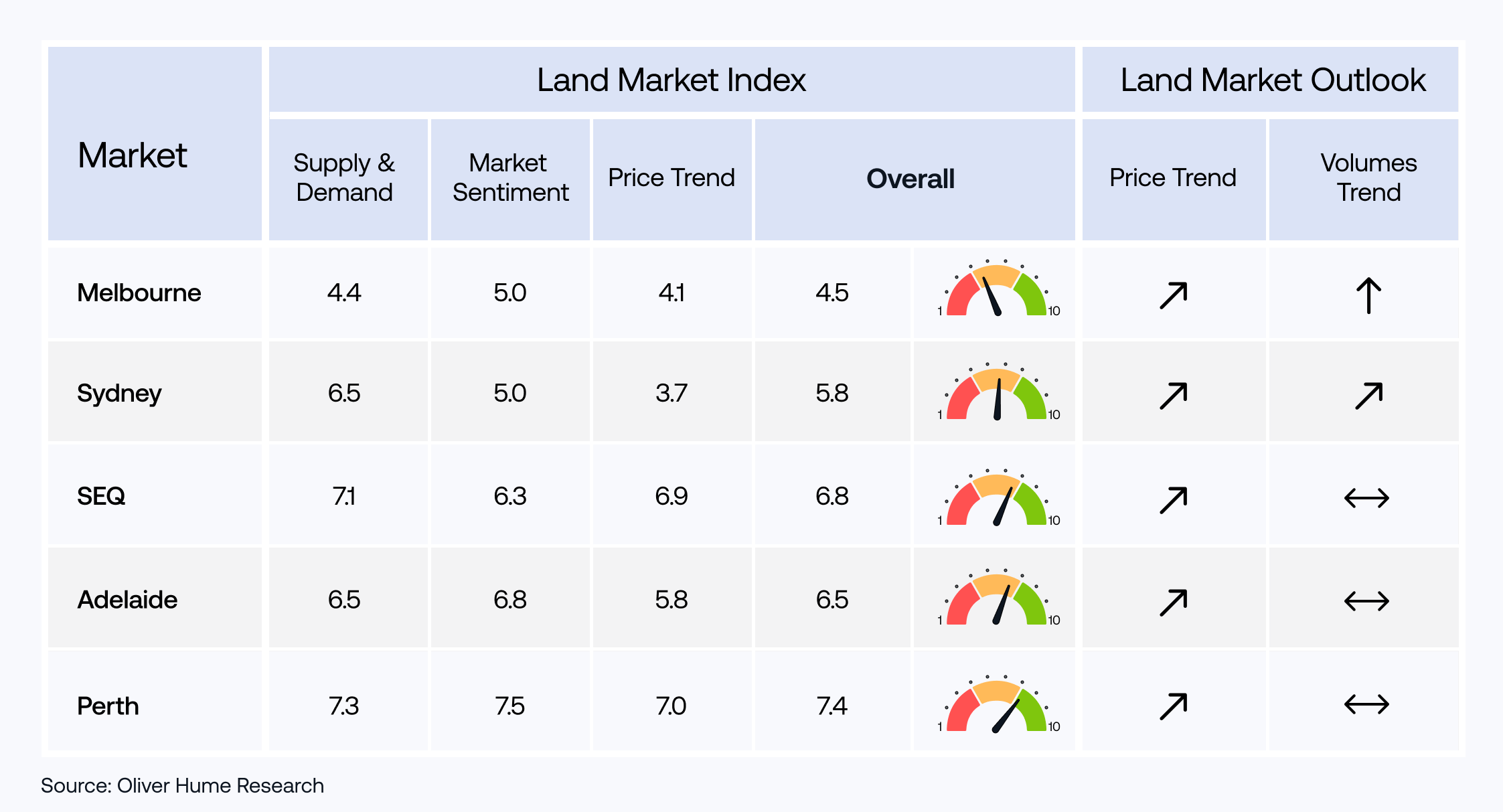
NOTES: Each sub-indicator and the overall index result will be scored from 0 – 10. A score of 5 means the sub-indicator or overall market is operating at a balanced market level, largely in line with the long term performance of that market or indicator. Scores above 5 means the indicator of market is outperforming the normalised (balanced) level of that market. Scores below 5 means the indicator of market is underperforming the normalised (balanced) level of that market. Oliver Hume estimates over 95% of outcomes will range between index scores of 2-8 (ie 5+/-3).
On the supply side, the national housing undersupply has been exacerbated in the last few years by lack of new supply in both key greenfield land markets and inner and middle ring apartment and townhouse markets.
“For attached product, ongoing regulatory and policy constraints have combined with historically high levels of construction cost growth to prevent feasibilities stacking up for anything but the most premium apartments,”
the report said.
“Recent changes to zoning policy, particularly in Melbourne and Sydney, have potential to increase the delivery of townhouses in our two largest capital cities, but these fixes won’t be quick. In the meantime, more needs to be done to unlock new greenfield land to fill this gap.
“Overall, the national land market performed strongly in 2025 on the back of strong demand from population growth, rate cuts and new first home buyer incentives driving improving sentiment. A strong established market provided room for land price growth while maintaining competitiveness.
Comments
Julian Coppini, Chief Executive Officer, Oliver Hume Property Group
“Buyers are continuing to show up despite the challenges presented by an uncertain interest rate environment, supply constraints and high prices.
Australians have an insatiable appetite for home ownership, and that aspiration has not changed, regardless of the rate cycle or the headlines of the day. People still want a place to call their own. They still want the security, lifestyle and long-term wealth creation that comes with owning a home. That underlying demand has proven remarkably resilient.”
Eliza Owen, Property Market Analyst
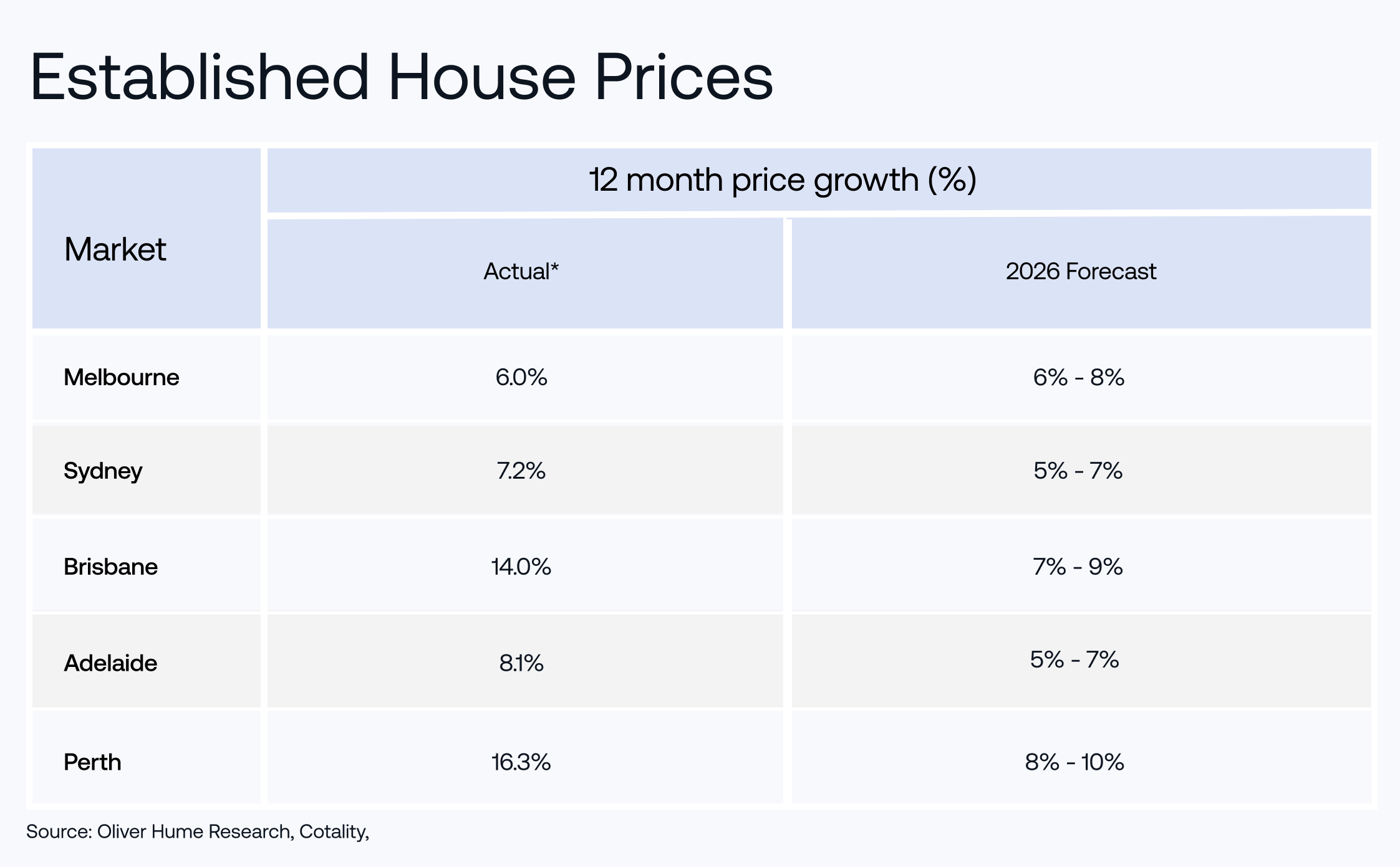
“The high land index measures in Perth and SEQ add another layer of insight to the extreme price pressures in these markets over a short period of time. Since the start of the 2020s, the median house value in Perth has gone from under $500,000 to over a million, and Brisbane is now the second-most expensive house market behind Sydney. Land shortages are a significant contributor.”
Despite renewed inflationary pressures and the potential for interest rate rises, land shortages mean price rises are possible in each of the capital cities this year, especially Perth and Brisbane, where fundamentals like job growth and population growth remain strong.”
Matt Bell, Oliver Hume Property Group Chief Economist
“Oliver Hume’s inaugural Land Index paints a picture of a strong national land market supported by solid supply and demand fundamentals across the country. Four of the five major land markets are operating at levels above the longer-term trend. The South East Queensland, Perth, and Adelaide markets have the majority of indicators performing historically strongly; Sydney has moved back above what is considered a normalised market, while Melbourne remains below normalised market activity levels.
The deteriorating geopolitical situation in the Middle East is not good for anyone. Higher oil (and petrol) prices and falling share market make people poorer, and confidence will undoubtedly take a hit. It could also negatively impact inflation, as imports become more expensive.
At the margin, this is negative for the outlook for residential markets; however, the main swing factor remains the outlook for inflation and interest rates.”
About The Index
The Oliver Hume Land Index and Residential Outlook is designed to provide greater understanding and transparency into Australia’s $16 billion a year land sales market. The quarterly Index has two core components.
State of Key National Land Markets
Provides a systematic assessment of the current condition of major land markets around the country. It allows users to compare relative performance across regions and identify the current phase of the cycle in each
market.
Each market receives a score calibrated to 5 as the benchmark for a balanced market. A reading above 5 indicates conditions operating above the long-term average, while a reading below 5 signals a market performing below trend. This normalised approach enables direct comparison across cities and regions and allows the research team to systematically rank performance nationwide.
Residential Market Outlook
A 12-month outlook for the key market metrics of land sales volumes and price growth and an outlook for established market house price growth for each market.
ENDS
Media enquiries:
Lilly Mackay
- Oliver Hume
- l.mackay@oliverhume.com.au
Frequently Asked Questions
.jpg)





.avif)
Enquire today and get the edge in property




Privacy policy. Privacy Collection Statement. Disclaimers.
© Copyright 2025. Powered by TAG