
- Oliver Hume Land Index and Residential Outlook is Australia’s first and only quarterly multi-market analysis of the land sector and draws on Oliver Hume’s decades of proprietary data.
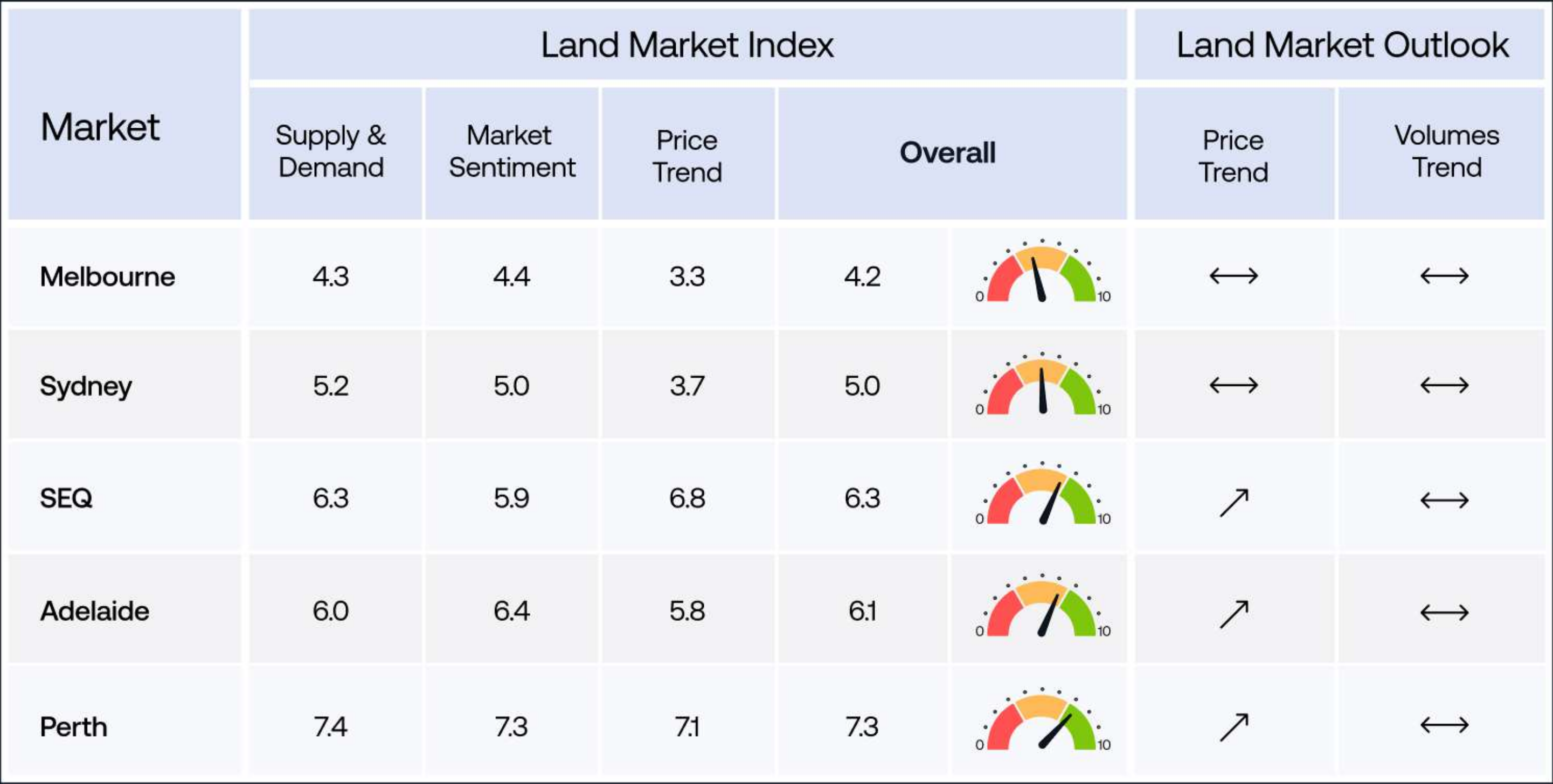
- The latest report shows markets easing in the March quarter, with two of the five major markets dipping below long-term trends.
- South East Queensland, Perth and Adelaide markets still have the majority of indicators performing historically strongly.
Oliver Hume Property Group’s latest Oliver Hume Land Index and Residential Outlook reveals Australia’s residential land market eased in the March quarter, with higher interest rates, the conflict in the Middle East and the resulting global oil price shock contributing to softer conditions across most markets.
The report finds that while underlying housing demand remains strong, economic uncertainty and affordability pressures have tempered buyer activity, leading to a more measured pace of land sales and price growth compared with the second half of 2025.
The Oliver Hume Land Index and Residential Outlook is the first comprehensive quarterly analysis of Australia’s major land markets and draws on decades of data and industry expertise to spotlight opportunities and risks in Australia’s $16 billion new land market.
The report draws on the company’s unparalleled internal land sales data and third-party information to provide insights on key markets in Melbourne, Sydney, South-East Queensland, Perth and Adelaide.
A Challenging Quarter
Oliver Hume Chief Economist Matt Bell said the combination of monetary tightening and global geopolitical instability had created a challenging environment for new residential land markets.
“The national picture has shifted from one where four of the five major land markets were operating at levels above longer-term trend, to now only three markets operating above trend,”
“Sydney has eased back closer to a market running in line with the longer term, while Melbourne has regressed and still sits well below balanced market operating levels.”
He said that while the March quarter showed some easing, the national land market performed strongly in the 12 months to March 2026, driven by strong demand from population growth, rate cuts delivered throughout 2025, and new first-home buyer incentives, which drove improving sentiment.
“A strong established market provided room for land price growth while maintaining competitiveness,” he said.
“We now expect volumes to remain flat over the next 12 months, reflecting some easing in the short term but recovering, potentially strongly, in late 2026 and early 2027 as the rates environment stabilises.”
“Prices are likely to remain weak in Sydney and Melbourne, but growth is expected to remain strongly positive in those heavily undersupplied land markets of Perth, Brisbane and Adelaide.”
Oil Shock Spreads
Mr Bell said higher oil prices have broader economic implications that flow through to both households and the development sector.
“The global oil shock has increased concerns around inflation and economic growth, while also contributing to higher costs across supply chains and construction. Combined with elevated interest rates, this has created a more cautious environment for both purchasers and developers.”
Despite softer conditions, the report notes that Australia’s structural housing undersupply, strong population growth and constrained land availability continue to support the long-term outlook for residential development.
Oliver Hume Chief Executive Officer Julian Coppini said the market was experiencing a necessary period of adjustment rather than a fundamental downturn.
“What we are seeing is a recalibration of the market after an extraordinary period of growth,”
Mr Coppini said.
“The headwinds facing the economy are real, but the underlying drivers of housing demand remain firmly in place. Australia continues to experience strong population growth, significant housing shortages and ongoing demand for well-located residential communities.”
Mr Coppini said periods of market moderation often create opportunities for both buyers and developers.
“When markets ease, affordability pressures can begin to stabilise and buyers have more time to make informed decisions. For developers, it provides an opportunity to focus on delivering quality communities that meet long-term demand rather than responding to short-term market volatility.”
About The Index
The Oliver Hume Land Index and Residential Outlook is designed to provide greater understanding and transparency into Australia’s $16 billion a year land sales market. The quarterly Index has two core components.
State of Key National Land Markets
Provides a systematic assessment of the current condition of major land markets around the country. It allows users to compare relative performance across regions and identify the current phase of the cycle in each market.
Each market receives a score calibrated to 5 as the benchmark for a balanced market. A reading above 5 indicates conditions operating above the long-term average, while a reading below 5 signals a market performing below trend. This normalised approach enables direct comparison across cities and regions and allows the research team to systematically rank performance nationwide.
Residential Market Outlook
A 12-month outlook for the key market metrics of land sales volumes and price growth and an outlook for established market house price growth for each market.
ENDS
Media enquiries to:
Mitchy Koper
Oliver Hume
M.koper@oliverhume.com.au
0417 771 778
Lilly Mackay
Oliver Hume
l.mackay@oliverhume.com.au
Frequently Asked Questions






.avif)
Enquire today and get the edge in property




Privacy policy. Privacy Collection Statement. Disclaimers.
© Copyright 2025. Powered by TAG