
- Oliver Hume Land Index and Residential Outlook is Australia’s first and only quarterly, multi-market analysis of the land sector and draws on Oliver Hume’s decades of proprietary data.
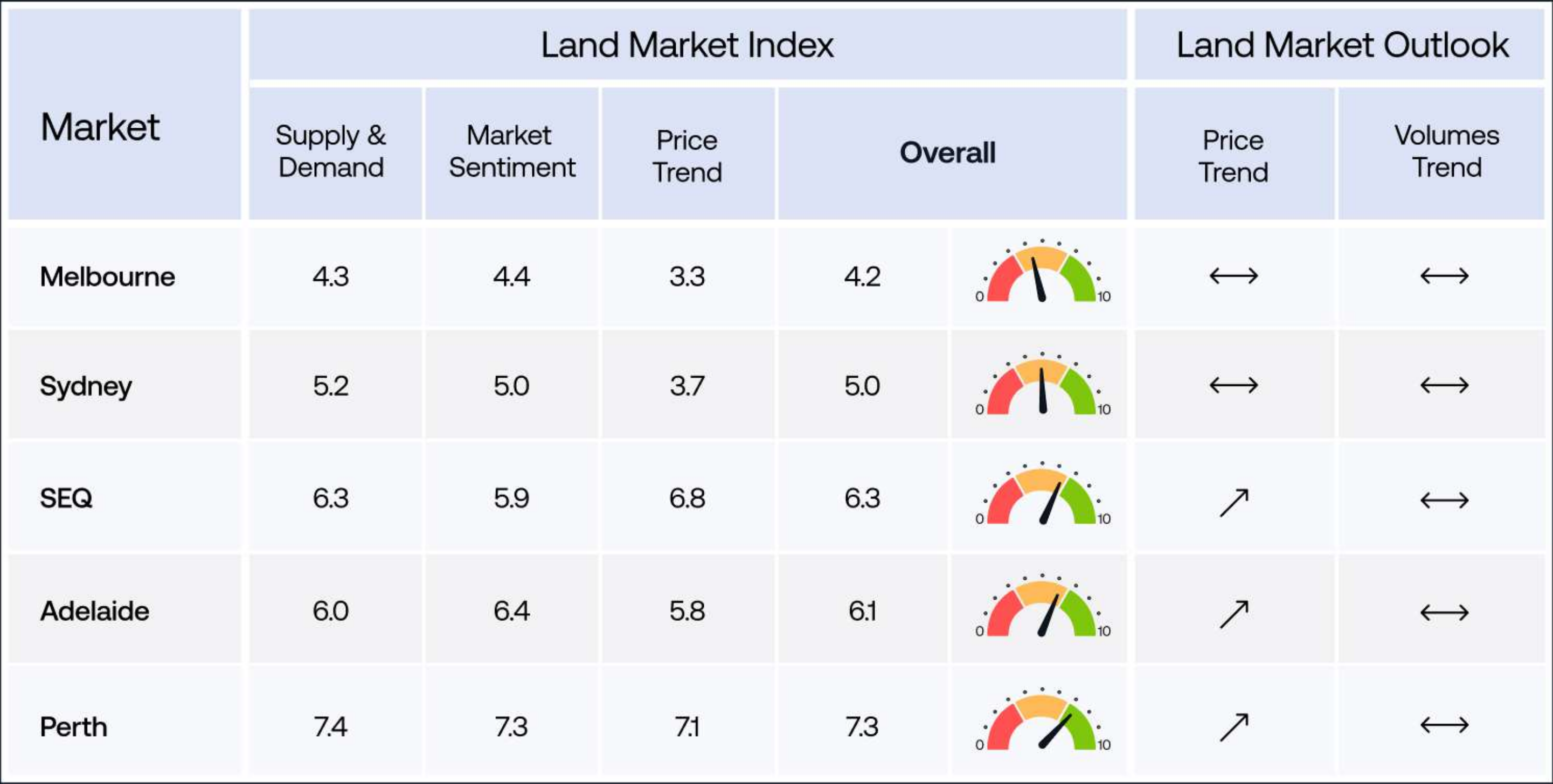
- SEQ’s overall Land Index score fell from 6.8 to 6.3 in the March quarter, but remains well above long-term average levels across most measures.
- Strong ongoing demand is likely to support land sales volumes over the next 12 months in the face of heavy supply constraints.
The South-East Queensland land market continued its strong performance in the March quarter despite ongoing supply issues affecting market activity, according to the latest Oliver Hume Land Index and Residential Outlook.
SEQ’s overall Land Index score fell from 6.8 to 6.3 in the March quarter, but remains well above long-term average levels across most measures
The major driver of the easing in the overall index score was a fall in the Supply and Demand sub-index due to a nearly 30% fall in sales volumes. Supply constraints are still holding back total sales volumes and demand indicators remain strong.
Clearance rate (sales as % of available stock) remains high and stock levels very low. Market sentiment softened slightly, with cancellation rates rising and consequently lowering the sub-index score from 6.3 to 5.9.
The Oliver Hume Land Index and Residential Outlook is the first comprehensive quarterly analysis of Australia’s major land markets and draws on decades of data and industry expertise to spotlight opportunities and risks in Australia’s $16 billion new land market.
It is produced by Oliver Hume’s team of research analysts, led by Chief Economist Matt Bell. It draws on the company’s unparalleled internal land sales data and third-party information to provide insights on key markets in Melbourne, Sydney, South-East Queensland, Perth and Adelaide.
Upward Pressure On Prices To Persist
Oliver Hume Chief Economist Matt Bell said strong ongoing demand was likely to support land sales volumes over the next 12 months despite heavy supply constraints.
“If supply is delivered in affordable corridors, given levels of pent-up demand, there is potential upside for strong increases in sales volumes, but this is not expected,” he said.
“Current greenfield capacity remains materially below normalised levels, limiting the market's ability to respond to demand that continues to run well above historical averages.
“The resulting supply shortfall is placing sustained upward pressure on prices, with this dynamic likely to persist over the short to medium term
“The risk is that the longer this price growth persists, the worse SEQ’s relative affordability becomes (both relative to other states and to the local established market) even as the established market remains strong.
He said price growth in the established housing market was forecast to be less impacted by Federal Budget taxation changes compared to Sydney and Melbourne, but still ease from current very high levels as demand shifts to other markets that have improved their relative affordability to Brisbane house prices.
Oliver Hume Property Group CEO Julian Coppini said the value proposition on new homes versus established housing remained relatively resilient, limiting potential market share loss and the impact on overall land sales volumes.
“Stronger investment demand for new home sales driven by the taxation changes could also be muted in part by the lack of available supply and stretched affordability.”
About The Index
The Oliver Hume Land Index and Residential Outlook is designed to provide greater understanding and transparency into Australia’s $16 billion a year land sales market. The quarterly Index has two core components.
State of Key National Land Markets
Provides a systematic assessment of the current condition of major land markets around the country. It allows users to compare relative performance across regions and identify the current phase of the cycle in each market.
Each market receives a score calibrated to 5 as the benchmark for a balanced market. A reading above 5 indicates conditions operating above the long-term average, while a reading below 5 signals a market performing below trend. This normalised approach enables direct comparison across cities and regions and allows the research team to systematically rank performance nationwide.
Residential Market Outlook
A 12-month outlook for the key market metrics of land sales volumes and price growth and an outlook for established market house price growth for each market.
ENDS
Media enquiries to:
Mitchy Koper
Oliver Hume
M.koper@oliverhume.com.au
0417 771 778
Lilly Mackay
Oliver Hume
l.mackay@oliverhume.com.au
Frequently Asked Questions






.avif)
Enquire today and get the edge in property




Privacy policy. Privacy Collection Statement. Disclaimers.
© Copyright 2025. Powered by TAG