
Land Markets Cool Further as Rate Hikes, Middle East War and Federal Budget Weigh on Conditions
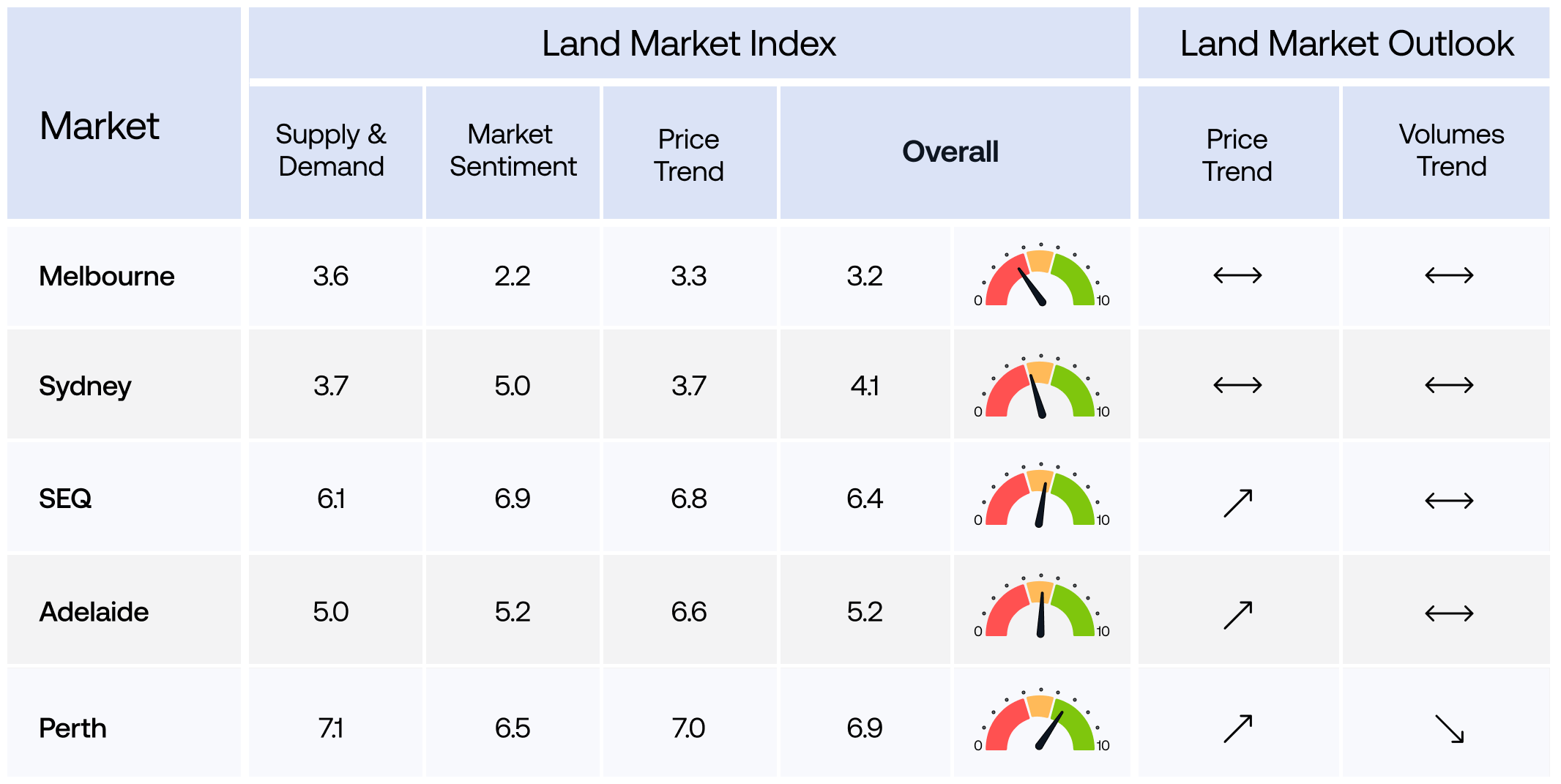
- Oliver Hume Land Index and Residential Outlook shows capital city land markets easing further in the June quarter, with only two of the five major markets now operating above long-term trend – down from three in March and four as recently as December 2025.
- South East Queensland and Perth markets still have the majority of indicators performing historically strongly, with SEQ the only market to record an increase in its Index score in June.
Oliver Hume Property Group’s latest Oliver Hume Land Index and Residential Outlook shows Australia’s residential land market cooled further in the June quarter, as the compounding effects of successive interest rate hikes, the Middle East conflict, and Federal Budget changes combined to dent confidence.
The report finds that while underlying housing demand remains strong, higher borrowing costs and short-term sentiment shocks have pushed land sales volumes and price growth lower across most markets, with Sydney joining Melbourne in operating below long-term average levels.
The Oliver Hume Land Index and Residential Outlook is the first comprehensive quarterly analysis of Australia’s major land markets and draws on decades of data and industry expertise to spotlight opportunities and risks in Australia’s $16 billion new land market.
The report draws on the company’s unparalleled internal land sales data and third-party information to provide insights on key markets in Melbourne, Sydney, South-East Queensland, Perth and Adelaide.
Oliver Hume Chief Economist Matt Bell said the combination of monetary tightening and global geopolitical instability had created the most challenging quarter for new residential land markets in over two years.
“It was only December 2025 when four of the five major land markets were operating at levels above longer-term trend. In March, this shifted down to three markets, and our June quarter results show that number has now fallen to just two,” he said.
“South East Queensland and Perth still have the majority of indicators performing historically strongly, with SEQ the only market to see an increase in its Index score in June. Adelaide moved back towards equilibrium, while Sydney regressed from a balanced market to join Melbourne operating below long-term average levels, right in line with their weaker established markets.”
Mr Bell said the Middle East War, the resulting global oil price shock, and three interest rate hikes delivered since the start of the year had combined to create the most uncertain quarter for the residential property market in over two years.
“The Middle East War commenced at the end of February, and expectations of oil price impacts flowing through to domestic inflation peaked in April and May,” he said.
“The impacts of the February and March rate hikes began to flow through, exacerbated by the May increase, and of course the Federal Budget announced changes to investor taxation of established properties on May 13,” he said.
“However, after July’s inflation data, markets are fully pricing in one more rate hike in 2026, with major forecasters also falling in line with one more hike before the rate cutting cycle begins in the second half of 2027. As always, the rates outlook remains the key short-to-medium-term driver of the outlook.”
Budget Hysteria Abates
“The hysteria related to the investor taxation announcements in the 2026 Federal Budget didn’t take too long to abate,” Mr Bell said. “The established market was clearly slowing prior to the Budget due to the February and March rate hikes and expectations of at least two more, and while clearly a short-term negative to sentiment, the rates environment and outlook was always going to remain the main driver of an established market slowdown.”
“Consumer sentiment has moved past the bottom experienced in May and June, as have other early residential market indicators such as auction clearance rates and open house attendance. They remain weak, and consistent with overall price easing, but aren’t pointing to the generational house price falls many have been forecasting.”
Mr Bell said Oliver Hume’s outlook for established market price growth over the next 12 months remained unchanged from March.
“We still expect falling established dwelling prices over the remainder of 2026, particularly in Sydney and Melbourne,” he said.
“But as the rates outlook stabilises (with or without a final hike) and consumer expect the next move in rates to be down, we expect the established market recovery to commence by mid-2027. Most established markets remain undersupplied to various levels, although this undersupply is expected to ease from recent highs, given the inevitable fall in investor demand.”
Mr Bell said the long-term impacts of the Federal Budget changes to investor taxation were still expected to be net positive for new dwelling demand, and secondary compared to the impact of interest rate movements and supply and demand dynamics.
“Some evidence of this is already appearing, with the heavy falls in investor activity in the established market not being reflected in the new dwelling market, where loans for construction, newly built dwellings and land held up well in the June quarter Lending Finance figures,” he said.
Oliver Hume Property Group Chief Executive Officer Julian Coppini said the June quarter had tested the market’s resilience, but the fundamentals underpinning long-term demand remained firmly in place.
“This was without doubt the most uncertain quarter for residential property in over two years, but what we are seeing is the market absorbing a series of shocks rather than a fundamental downturn,” Mr Coppini said.
“The headwinds are real and compounding – rate hikes, a global oil shock and Budget-related uncertainty all landed in the same quarter. But population growth remains strong, housing shortages persist and demand for well-located residential communities has not gone away.”
Mr Coppini said the stabilisation of the macroeconomic outlook since March was an encouraging sign for the year ahead.
“As the Middle East crisis drags on, the flow-through to oil prices, domestic fuel prices and inflation has been far less severe than initially feared. That stabilisation gives both buyers and developers more confidence to plan for the year ahead, even as we work through a period of short-term softness.”
About The Index
The Oliver Hume Land Index and Residential Outlook is designed to provide greater understanding and transparency into Australia’s $16 billion a year land sales market. The quarterly Index has two core components.
State of Key National Land Markets
Provides a systematic assessment of the current condition of major land markets around the country. It allows users to compare relative performance across regions and identify the current phase of the cycle in each market.
Each market receives a score calibrated to 5 as the benchmark for a balanced market. A reading above 5 indicates conditions operating above the long-term average, while a reading below 5 signals a market performing below trend. This normalised approach enables direct comparison across cities and regions and allows the research team to systematically rank performance nationwide.
Residential Market Outlook
A 12-month outlook for the key market metrics of land sales volumes and price growth and an outlook for established market house price growth for each market.
ENDS
Media enquiries and interview requests to:
Lilly Mackay
Oliver Hume
l.mackay@oliverhume.com.au
0437 899 949
or
Ben Ready
RGC Media & Mktng
ben@rgcmm.com.au
0415 743 838
Frequently Asked Questions



.avif)
Enquire today and get the edge in property




Privacy policy. Privacy Collection Statement. Disclaimers.
© Copyright 2025. Powered by TAG