.jpg)
National Research Manager at Oliver Hume Property Group
Housing affordability gap widens as buyer demand shifts smaller
The housing affordability gap is now wide enough to shut most buyers out of traditional house and land - even in Melbourne, one of Australia's more affordable capital city markets. Strong population growth, changing demographics and rising living costs are reshaping housing demand across Australia's capital cities, and the flow-on effects are already visible in how buyers are choosing to enter the market.
This article draws on Oliver Hume's June Quarterly Market Insights (QMI) - our proprietary quarterly research report. The full report, including detailed corridor-level buyer affordability analysis, medium-density approval forecasts, and detached housing trend data, is available exclusively to registered subscribers.
Register to receive the full QMI
Why the affordability gap keeps widening
Demographic change is one of the key drivers shaping future housing demand. Population growth is expected to remain strong over the long term, supported by growth in smaller households and a rising younger, middle-income renter cohort - a group that will expand the future home buyer pool.
At the same time, higher interest rates and rising living costs have significantly reduced purchasing capacity. That's widened the gap between what many households, particularly first home buyers, can afford and current dwelling prices.
Underlying demand remains strong. Purchasing power has not kept pace.
Even Melbourne's affordable stock is out of reach for most buyers
Arash Manafi’s analysis suggests this affordability gap is creating a growing mismatch between buyer purchasing capacity and the current product mix.
Even in Melbourne, one of Australia's more affordable new housing markets, the majority of available house and land product is priced beyond the purchasing capacity of most potential buyers - particularly first home buyers. Many investors and upgraders now require deposits well above the traditional 20–30% of house prices to access a significant share of available stock.
Together, these demographic and affordability pressures are expected to drive a structural shift in housing demand towards smaller and more affordable housing products. Detached housing will continue to play an important role - but townhouses and other medium-density housing are expected to account for a growing share of future demand as buyers increasingly prioritise affordability.
Casey growth corridor: an early signal of the shift
Casey provides an early example of how these structural trends are already emerging. As one of Melbourne's largest growth corridors, Casey has one of the more constrained structural land supply pipelines, with limited approved zoned supply outside active projects to support future estate commencements.
This tightening supply pipeline is placing upward pressure on land values - and eroding the traditional affordability advantage of greenfield housing.
Oliver Hume enquiry and sales data indicate affordability pressures are already changing buyer behaviour in Casey. Demand for lots below 400sqm has increased, reflecting buyers' reduced purchasing capacity and growing demand for smaller products. Casey's buyer profile also continues to be dominated by upgraders, likely reflecting the affordability challenges facing first home buyers and the purchasing advantage provided by accumulated housing equity.
The full Casey corridor buyer analysis is published in the complete June 2026 QMI.
Register to access the full report
Townhouses now suit more buyers than house and land
By comparison, townhouse products are significantly better aligned with buyer purchasing capacity. Oliver Hume's analysis indicates townhouses can cater to around 60% of potential buyers in Casey, compared with just 30–40% for house and land products.
Reflecting this shift, the share of medium-density approvals in Casey has increased steadily in recent years and is forecast to rise from around 20% currently to 30–40% over the next five years.
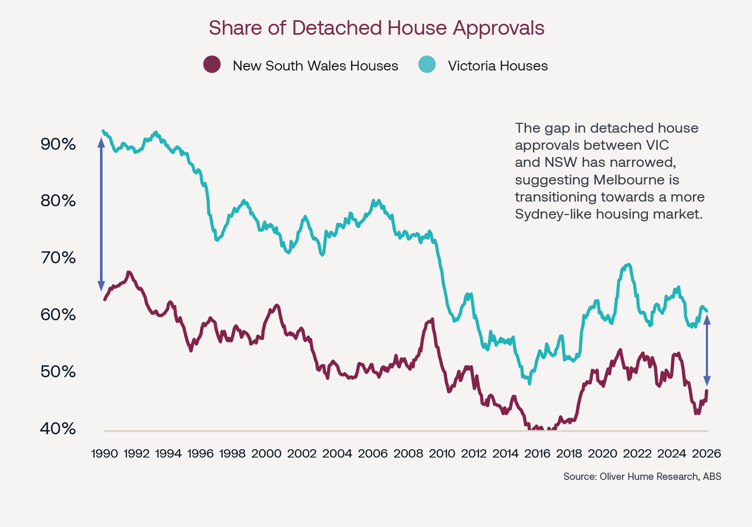
Nationally, the data tells a similar story. Oliver Hume Research and ABS figures show the historic gap in detached house approvals between Victoria and New South Wales has narrowed sharply since the 1990s, suggesting Melbourne is transitioning towards a more Sydney-like housing market - one where medium-density product plays a far larger structural role.
While Casey provides an early example, these trends are unlikely to remain isolated. As affordability pressures persist and land supply becomes increasingly constrained, many growth markets are expected to experience a similar structural shift towards smaller and more affordable housing products.
Access the full June 2026 Quarterly Market Insights
This article covers only part of what's in the full report. The complete June 2026 QMI includes:
- An affordability analysis across Victoria, Queensland and South Australia
- Julian Coppini on the opportunities and risks shaping the market, from investor taxation changes to the outlook for credit availability.
- Matthew Bell on how the land markets held up in June considering the economic and market disruptions
- Toby Adams Head of Research, UDIA National & UDIA WA, on the UDIA-developed National Housing Pipeline: understanding where, when and how new homes can be delivered.
- Adam Duster writing about what first home buyer activity since the Federal budget means for off-the-plan developers.
The QMI is produced every quarter and distributed exclusively to Oliver Hume's registered network. Registration is free.
Register to receive the June 2026 QMI and all future editions
Frequently Asked Questions
Why is there a housing affordability gap in Australia?
Population growth, changing demographics and rising living costs have widened the gap between what many households - particularly first home buyers - can afford and current dwelling prices. Higher interest rates have significantly reduced purchasing capacity even as underlying housing demand stays strong.
Is Melbourne housing still affordable?
Even in Melbourne, one of Australia's more affordable new housing markets, most available house and land product is priced beyond the purchasing capacity of most potential buyers, particularly first home buyers, according to Oliver Hume research.
Why are townhouses becoming more popular than house and land?
In the Casey growth corridor, Oliver Hume analysis found townhouses can cater to around 60% of potential buyers, compared with just 30–40% for house and land products, because they better align with reduced buyer purchasing capacity.
What is happening to medium-density housing approvals in Casey?
The share of medium-density approvals in Casey has increased steadily in recent years and is forecast to rise from around 20% currently to 30–40% over the next five years.
How is buyer demand for lot sizes changing in growth corridors like Casey?
Oliver Hume enquiry and sales data show demand for lots below 400sqm has increased in Casey, reflecting buyers' reduced purchasing capacity and growing demand for smaller, more affordable products.
Where can I access the full Q2/2026 Oliver Hume Market Insights report?
The full report is available exclusively to registered subscribers. Register to receive the full QMI




.avif)
Enquire today and get the edge in property




Privacy policy. Privacy Collection Statement. Disclaimers.
© Copyright 2025. Powered by TAG